
Private debt capital is concentrating in funds of $5bn or more, and a fund has a set time in which to put its money to work. We set that clock against the pace at which lending vehicles take on new borrowers. The maths leaves the originator that needs less than $50m of its own funding with fewer places to go.
A fund that closes at $8.5bn with a three-year investment period would have to place about $2.8bn a year before leverage, recycling or extensions. At a ticket of $50m, that is 57 new tickets a year, more than one a week for three years.
The fastest sustained pace we can find in public filings is 23 new counterparties a year, in vehicles of $3bn or less.
The gap between those two numbers marks where a growing share of the market’s capital cannot go, because the money is moving into the funds for which the sum is hardest.
The money
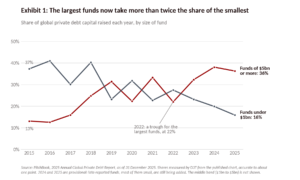
In the first half of 2026, funds of $5bn or more took 56.9% of the private debt capital raised worldwide, PitchBook reports, against 42.5% a year earlier. In the United States the figure was 69.7%. Funds under $1bn took about 28% of capital in 2022 and about 16% in 2025.
The line has not been straight. The largest funds took 33% in 2021 and 22% the year after, and the first-half figure will be revised as late closes, most of them small, are counted. Exhibit 1 shows the direction over a decade.
Asset-based finance is raising record sums, though no provider publishes a fund-size series for it and many managers run it as a sub-strategy within a larger private credit fund. With Intelligence counts a record $47.4bn raised by specialty finance funds in 2025 across 28 funds, about $1.7bn each. This year’s largest close sits well above the $5bn line: in June, Ares closed Pathfinder Fund III at $8.5bn of commitments, and investors holding about $4.0bn in its predecessor, Pathfinder II, elected to extend that fund’s reinvestment period by two years. On 1 October Oaktree held the final close of its Asset-Backed Finance Fund with $2bn of commitments.
The clock
A fund does not have unlimited time to invest, and the papers US public pension boards publish when they commit to these funds state how long it has. Vermont’s 2021 board pack on the first Ares Pathfinder fund, a closed-end fund, gives an investment period of three years from the final close. Rhode Island’s 2022 consultant memo on an evergreen Atalaya fund gives an initial three-year investment period that investors can extend. Three years means about a third of the fund placed each year, before recycling and any extension.
The same papers say how the managers expected to do it: 30 to 50 investments a fund in the Ares and Atalaya papers, which is 10 to 17 a year over three years, and 40 to 60 in a 2025 paper on an evergreen TPG Angelo Gordon fund that sets no fixed period, at a typical size of $20m to $75m. These are stated plans in three papers, two of them from 2021 and 2022, and they describe funds much smaller than today’s largest.
The pace
Plans can be set against what vehicles do. Drawdown funds publish no positions, but 11 SEC-registered asset-based finance vehicles file theirs every quarter. We compared each filing with the one before it across eight quarters and counted what was new: 258 direct positions, with 136 new counterparties. These are quarter-end snapshots: a loan made and repaid within a quarter is not seen, and further lending to an existing borrower is not a new counterparty. Counting new positions instead of new counterparties, the fastest sustained pace is about 38 a year.
Pace rises with size up to a point. Among the vehicles with at least a year of filings it runs from 3 new counterparties a year at $0.2bn of net assets to about 22 at $1.1bn. The vehicle at $2.6bn adds 23. None sustained more than about two dozen. Across all nine vehicles there is no relation between pace and size, and two of the five with a year of filings invest mostly through other funds.
This is the pace of single vehicles, all under $3bn, and a manager running several funds will share a deal between them. Nothing public shows the pace of a fund above $5bn. It is the only observed measure available, and it is not far above the 10 to 17 a year in the pension papers.
The sum
Put the clock and the pace together. A $450m fund placing a third of its capital a year across 23 new borrowers needs its average ticket, the amount the fund itself commits to each, to be under $7m. A $2bn fund needs $29m and a $2.9bn fund $42m, both inside the range the pension papers give. The average ticket passes $50m at a fund size of about $3.4bn. At $5bn it has to be $73m, and at $8.5bn $124m.
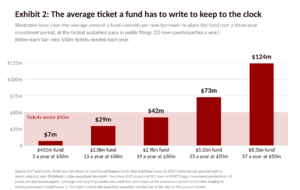
Run the other way, the same sum gives the number of $50m tickets each fund would have to write. At $2bn it is 13 a year and at $2.9bn it is 19, both within the pace observed.
At $5bn it is 33, about one and a half times the fastest pace and twice the top of the managers’ own plans. At $8.5bn it is 57, two and a half times that pace. Leverage and recycling are left out, and both add to the amount to be placed.
The conclusion is narrow: above about $3.4bn a fund’s average ticket has to exceed $50m unless it takes on new counterparties faster than any vehicle we can observe, and at megafund scale a book made mainly of tickets under $100m is almost impossible. Ares’ own account fits the base case: an Ares partner told Alternative Credit Investor in August that “the average deal size historically was $50 to $100m, today it is $100m to $300m”.
Where the money goes instead
The filings show three routes. They also rule out the simpler story that large funds do not hold small positions, because every vehicle we examined holds them in number.
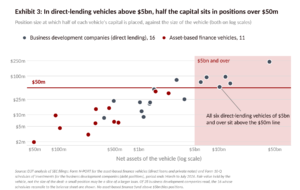
The first route is larger tickets. Across the 11 asset-based finance vehicles, 98% of direct positions are under $50m, and of the 258 new positions counted all but two were. Nine of the 11, each under $600m of net assets, hold nothing larger. The 12 positions of $50m or more all sit in the two largest vehicles, at $1.6bn and $2.4bn, where they hold about a third of the direct book. The position size at which half a vehicle’s capital sits rises with the size of the vehicle, across the sample and over the eight quarters. One vehicle grew from $0.1bn to $1.6bn of net assets in a year, and that midpoint moved from $22m to $40m.
In this analysis a position is what one vehicle holds, not the size of the deal, and for revolving lines the filings carry the full commitment, drawn or not: in the two vehicles that list them by borrower, about a third of the value on those lines was undrawn. On a funded basis all four positions of $50m or more in the $1.6bn vehicle stay above $50m.
No asset-based finance fund above $5bn files positions, so we ran the same test on 16 business development companies, which are direct lenders and file full schedules, from $0.4bn to $43bn of net assets. We tried 28; the 12 whose schedules did not reconcile to the balance sheet, some of them large, are left out. In all eight with net assets under $2bn, more than half the book sits in positions under $50m. The two between $2bn and $5bn are mixed. In all six at $5bn and over, more than half sits in positions above $50m, and the size at which half the capital is placed runs from $53m to $236m. Small positions do not disappear: the $43bn vehicle holds 676 under $25m. A small position in a vehicle of that size is often a slice of a large loan, and the filings cannot tell the two apart.
The second route is buying in bulk. In the twelve months to 4 October we found twelve announced forward-flow programmes, in which a capital provider agrees to buy an originator’s loans as they are made. Together they run to as much as $14.2bn, and the smallest is $200m; seven of the twelve are $1bn or more.
Exhibit 4: Forward-flow programmes announced, October 2025 to October 2026
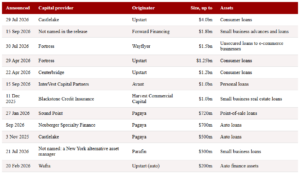
Source: company releases and trade press, as announced. The Sound Point and Neuberger programmes are as reported by third parties. Sizes are maximum amounts over terms of 12 months to three years where a term is stated, not capital drawn.
The registered vehicles show the same thing from the inside. Four of the 11 hold 34,722 whole loans and advances bought through platforms, worth $411m. One $1.6bn vehicle reports $434m of unfunded commitments to buy assets through such programmes, $325m of it lending to small and medium-sized businesses, against $145m of unfunded loans to named borrowers.
The third route is to own or anchor the originator. KKR committed $350m to launch Akrapoint Commercial Capital on 22 September, and Oaktree is reported to have provided a facility of up to $300m to Northbase Finance in March.
Each route puts small loans into large funds. None of them is a $20m facility to an originator. In effect, the funds are replicating the bank wholesale model at a different attachment point.
What that leaves
The originator that needs less than $50m of its own funding, to build a book it has not yet scaled, sits between these routes. It is too small to be the counterparty on a programme of hundreds of millions and too large to be a loan at the end of one. It can still be one of the $20m to $75m investments a $2bn fund plans to make, and that is the part of the market losing share: funds under $5bn took 57.5% of global capital in the first half of 2025 and 43.1% a year later.
The share fell because the largest funds’ dollars rose, not because the smaller funds’ fell: on first-print figures funds under $5bn raised about $65bn in the first half of 2025 and about $68bn in the first half of 2026, while funds of $5bn or more went from about $48bn to about $90bn. The originator’s other source of funding would be a bank, and the Federal Reserve’s July 2026 survey of senior loan officers reports significant net shares of banks describing their standards on loans to non-bank financial institutions as at the tighter end of the range since 2011. Bank lending to non-bank financial institutions as a whole has grown fast, at 21.9% a year from 2010 to 2024 on FDIC figures, but the survey describes standards, not volumes.
Nobody publishes how many such originators there are. The nearest measures mostly point to more activity: equipment finance new business volume is up 17.3% for the year to August on ELFA’s index, a figure for all lender types in which banks set a record in August, and non-bank asset-based lenders reported higher commitments in each of the last three quarters in SFNet’s survey. Monitor’s list of equipment lessors below its top 100 went the other way, from 35 reporting companies to 25, partly through mergers.
D3T works on facilities of under $50m, so we have an interest in the conclusion, and we have stated the limits of the evidence where they fall. Above a certain fund size the calendar leaves less room for the small facility, and each megafund close moves more of the market’s capital past that point. None of this says capital for small facilities is scarce: the same Ares partner says transactions below $100m typically attract 10 to 15 term sheets. A fund above $5bn that published its positions would show how far the direct-lending pattern carries into asset-based finance. None does yet.
D3T Capital LTD is an Appointed Representative of Capricorn Fund Managers Limited, which is authorised and regulated by the Financial Conduct Authority. D3T Capital LTD is incorporated in England and the registered office is at Unit 17 Orbital 25 Business Park, Dwight Road, Watford, WD18 9DA, United Kingdom.
The investment products and services of D3T Capital LTD are only available to professional clients and eligible counterparties. They are not available to retail clients.
This article is general market commentary. It does not constitute an offer, invitation or inducement to invest in any product or service, it is not investment research, and it is not directed at retail clients. Managers and funds are named from public releases, regulatory filings, public pension board papers and trade-press interviews, with dates, and figures drawn from them are directional. No view is expressed on the strategy, risk or performance of any manager or fund.